
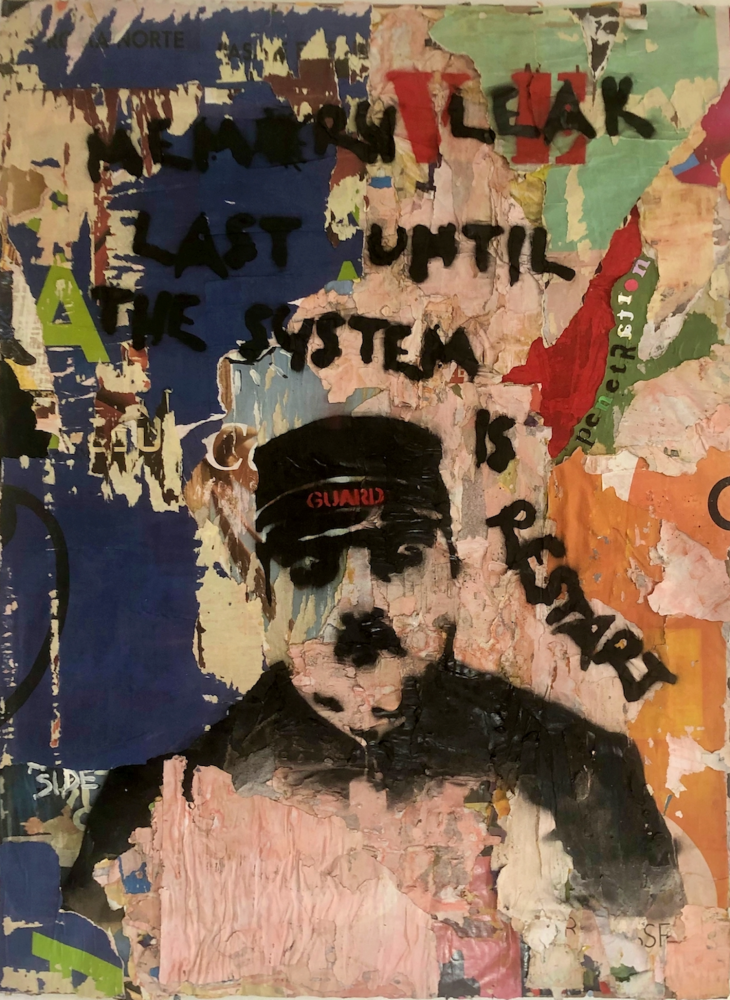
Torn poster layers peel from a New York wall, revealing fragments of typography, color, and lost advertising—an accidental palimpsest of the city’s memory. This is the terrain of affichage lacéré, or torn poster art, a practice that emerged in mid‑century Europe when artists such as Jacques Villeglé and Raymond Hains began salvaging ripped street posters and re‑presenting them as autonomous works. Closely linked to décollage and the Nouveau Réalisme movement, these “affiches lacérées” have long since left the street; they hang today in major institutions from the Kaiser Wilhelm Museum to Tate Modern and MoMA, recognized as both social documents and avant‑garde abstraction. Borna Libertines situates itself squarely within this lineage, treating torn poster surfaces not as vandalism but as a legitimate, museum‑tested language for re‑imagining urban histories, brand imagery, and subcultural noise.
A brief history of torn poster art – Affichage Lacéré
Torn poster art emerged in postwar Europe when Jacques de la Villeglé and Raymond Hains began scavenging ripped street posters from Paris walls in the late 1940s and 1950s. Rather than painting over them, they treated these anonymous urban scraps as ready‑made abstractions, transferring whole sections of lacerated advertising onto canvas and panel. Their walks through the city became a form of dérive: drifting through working‑class neighborhoods, hunting for the most charged surfaces—where typography, color, and political slogans collided by chance. ubugallery
At the same time in Italy, Mimmo Rotella began tearing cinema and advertising posters from the streets of Rome, developing the décollage technique that removed rather than added material. For Rotella, ripping posters was both aesthetic experiment and protest against a mass‑media society he saw as saturated with empty images. In all three cases, the street itself functioned as a kind of printing press and archive. Posters were continuously pasted over one another, so each wall held a stratigraphic record of commercial culture—cinema, politics, fashion, and consumer goods layered in time. Tearing into these surfaces exposed buried fragments of older campaigns and forgotten events, revealing hidden layers of meaning that the artists simply framed and titled. Today, institutions such as Tate and MoMA explicitly describe Villeglé, Rotella, and their peers as pioneers of décollage with ripped or lacerated posters, cementing torn poster art as a canonical movement rather than an act of vandalism. MoMA
Why torn posters became political
As artists and activists began to understand advertising as a language of power, tearing posters shifted from a purely aesthetic gesture to an explicitly political one. Commercial and propaganda posters rely on smooth, flawless surfaces to project certainty: perfect faces, corporate logos, campaign slogans all demand to be read as authoritative and inevitable. Décollage turns that logic inside out. By ripping, cutting, or peeling away the paper, artists like Jacques Villeglé and Mimmo Rotella “unstuck” these images from their original context, introducing chance, rupture, and illegibility where there was supposed to be clarity and control.nationalgalleries+3
Institutions such as the National Galleries of Scotland note that décollage “allowed Nouveau Réalistes the chance to critique and disrupt the plethora of public advertising” by destroying its source images, an act Villeglé described as an “antidote to all propaganda.” Each torn surface reveals not just visual chaos, but the violence, conflicts, and anxieties buried within layers of political campaigns, wars, and consumer fantasies. In this sense, the torn poster becomes a kind of street-level editing tool: it censors the commercial message while amplifying the underlying tensions of the city. Borna Libertines inherits this tradition, using lacerated poster textures to question contemporary branding and media, transforming destruction of the surface into a critical way of seeing.
Borna Libertines and the New York tradition
Borna Libertines carries the torn‑poster lineage of Villeglé, Hains, and Rotella into the grit of contemporary New York, translating European décollage into an East Village–inflected, underground visual language. Based in New York City and working between NYC, Europe, Mexico City, and Tokyo, he mines the city’s worn walls, construction fences, and billboards much like his predecessors combed Paris and Rome, but with a distinctly 21st‑century media overload as his backdrop.instagram+3
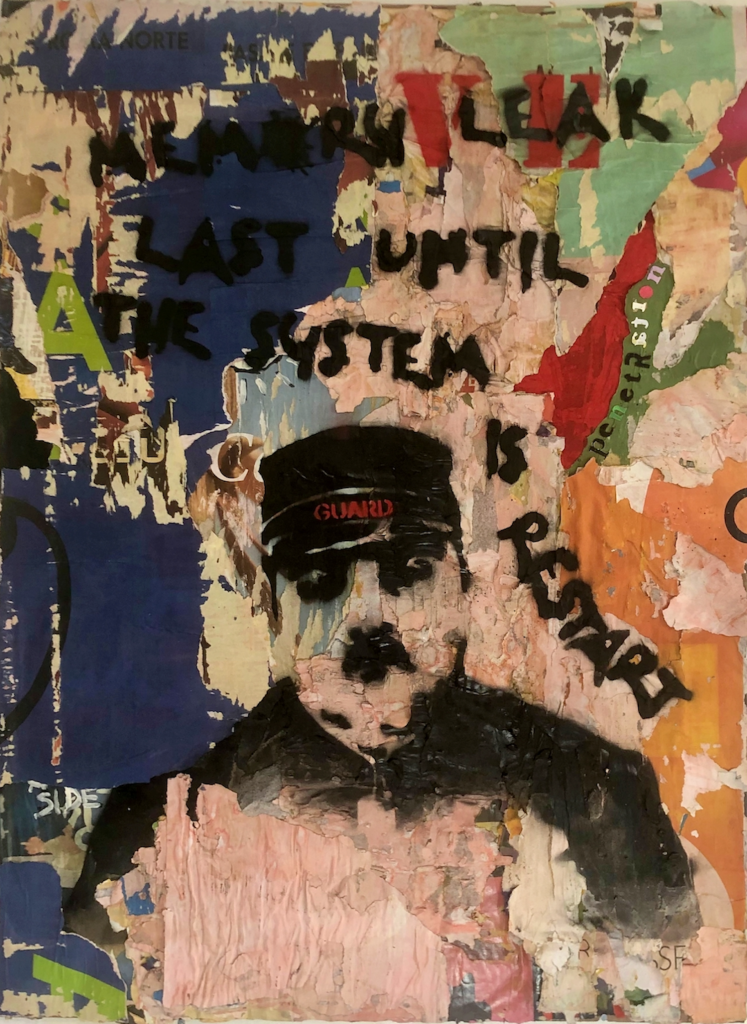
His raw material is real street ephemera: torn advertising posters, flyposters, stickers, and fragments of typography, overlaid with graffiti, paint, and stenciled marks collected from everyday urban circulation. These scraps of popular artifacts and commercial imagery are ripped, recomposed, and layered so that one poster bleeds into another, echoing classic décollage while rooting the work in the specific texture of New York streets. The resulting surfaces feel like lifted sections of a city wall—urban core samples that bring the streetscape directly into the gallery or onto apparel.
Conceptually, Borna’s collages are charged with humor, eroticism, and sociopolitical critique: punch‑line juxtapositions, spliced bodies, and fractured slogans that expose how desire, gender, and power are marketed to us. By reconstituting advertisements and pop imagery into chaotic, sensual fields, he mirrors a society “driven by communication” and “media obsession” while simultaneously sabotaging its visual commands. This duality—seduction and disruption—links his practice back to the torn‑poster avant‑garde while keeping it firmly anchored in our present. bornalibertines
Borna Libertines has presented this work internationally, including a solo exhibition at Hashtag Gallery in Mexico City and a major show at Hotel Lone in Rovinj, Croatia, extending his New York–born practice into a global circuit of urban image‑making. Further information on his art, exhibitions, and apparel can be found at bornalibertines.com and the /about-us/ page of the Borna Libertines shop.
From gallery walls to wearable art
On fabric, Borna Libertines treats each garment as a portable slice of the wall—a way to turn the fixed gallery collage into something that moves through the city on a body. Translating a lacerated poster composition to apparel means deciding which fragment becomes the “hook” image, how much visual noise to keep, and where to crop so the main collision of text, figures, and color lands across the chest or back rather than disappearing into seams and folds. Some fine details and micro‑layers are inevitably lost at scale, but the essential torn‑poster logic—overlapping typography, ruptured imagery, graffiti marks—is preserved and amplified by print, embroidery, or placement on sleeves and hems.
In the Liberty Oversized T‑shirt, the Liberty collage is reworked into a bold chest graphic that reads like a mini manifesto on freedom and self‑expression, distilling a larger wall piece into a clean, high‑impact front image. The Erotica T‑shirt series pushes the opposite way: the erotic illustration and fragmented text keep the tension and humor of the original collage while using a darker ground and simplified color fields to enhance legibility and contrast on cotton. Together, pieces like the Liberty unisex T‑shirt and Erotica Dark Softstyle Unisex T‑shirt show how Borna’s torn‑poster aesthetics become wearable manifestos without losing their underground edge.
FAQ
What does affichage lacéré mean?
Affichage lacéré is French for “torn poster,” a fine art practice where artists rip and reassemble layers of street posters to create new images, also known as décollage.
Who are the most famous affichage lacéré artists?
Key figures include Jacques Villeglé, Raymond Hains, Mimmo Rotella, and François Dufrêne, all associated with the postwar Nouveau Réalisme and Affichistes movements.
Where can I see affichage lacéré art in New York?
The Museum of Modern Art (MoMA) in New York holds important torn‑poster works by Jacques Villeglé, such as “122 rue du temple” and “bleu O noir,” regularly shown in its collection galleries.
How is Borna Libertines’ art different from graffiti?
Graffiti usually focuses on hand‑drawn lettering or characters applied directly to walls, while Borna Libertines builds studio collages from found posters, ads, and ephemera, then translates them into prints, canvases, and garments. His work sits in the torn‑poster and collage tradition, even when it incorporates graffiti marks.
Affichage lacéré doesn’t stop at the gallery wall; it keeps moving—through the street, into exhibitions, and finally onto your back. The same torn posters, erotic fragments, and subversive jokes that define Borna Libertines’ canvases are reworked into oversized silhouettes built for everyday wear, turning each T‑shirt into a portable slice of New York concrete. If you want to literally wear the movement, explore the oversized T‑shirt collection at Borna Shop, where collage‑driven prints, relaxed fits, and underground attitude push affichage lacéré into the language of contemporary streetwear.bornashop+1
Leave a Reply